 The average Utah household spends 65% of its water usage on the outside of the house.
The Conservation Garden Park, located in West Jordan, faces the tough job of reminding people that, in spite of the desert climate where water becomes more scarce every year, a lush, green landscape can still be accomplished with minimal resources.
“The main problem is that most people simply overwater their lawns,” says Cynthia Bee, the conversation programs assistant. “The average Utah lawn only needs twenty-five to thirty inches of water every season, but we are currently averaging about fifty-five. That’s enough to water a rainforest!”
Garden Manager Clifton Webb says that the first step to water conservation is to understand that most yards don’t even need to be watered until mid-May, starting with every fourth early-morning. This will force the roots to grow deeper.
By the time the year’s temperatures reach their highs, about a half-inch of water (roughly 21 minutes a sprinkler cycle) every third morning is all that is necessary. Doing this alone could cut each household’s summer water usage by 50%.
“Most of of the time, people don’t even use all of their grass,” affirms Smith. “If there’s a patch of yard you don’t use, replace the grass with something you will use, such as a patio or playground.”
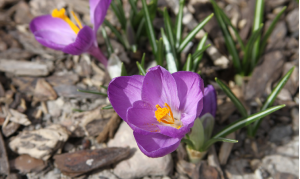
Walking around the Garden Park, it’s easy to mistake the area for a picturesque estate. The blooming flowers, the green turfs and the tall trees and shrubs all represent plants that can survive in Utah with little to no supplemental water.
The tour provides Utahns with examples of six different neighborhood landscapes: high mountain desert, woodland, harvest, perennial, traditional, and modified traditional—proving that almost every design can be accomplished. The Garden Park’s website lists 904 plants that can be added to any landscape in our climate. Hydro-zoning—grouping plants that soak up similar amounts of water—is commonplace here, helping limit the water intake in each space.
Since 2000, the state has already seen a decrease in 25% of water-usage, per capita. While this number is promising, “We still consume way too much,” says Smith.
Since the price of water is likely to increase, with just a little bit of knowledge and application, Utahns can save on their water bills and conserve on this valuable resource.
The Conservation Garden Park is located at 8275 S. 1300 W. in West Jordan. Visit www.conservationgardenpark.org for more information. For more information on how to conserve water on your yard, please visit: www.utahstories.com/2013/05/03/watering-your-yard/