Bareback astride mustangs, feathers in their hair, Indian warriors are portrayed in Maynard Dixon’s painting Indian Warriors. Their landscape is incredibly the landscape in which we now live.
The Bierstadt to Warhol: American Indians in the West exhibit at the Utah Museum of Fine Arts is a journey through Western Native American history from the late nineteenth century to the present. The exhibit spans 160 years and represents Native people from the Rocky Mountains, plains, and southwest regions of the US, particularly Taos, New Mexico.
The exhibit represents four major art movements beginning with the broad, atmospheric landscapes of the Hudson River Valley done by European-trained artists coming west during the late 1800s.
One strikingly beautiful but idealized painting by an unknown artist is called What an Indian Thinks. In this painting, a contemplative Indian sits on a bluff overlooking a valley. Another artist, Thomas Moran, also romanticized the landscape through exaggerated color and atmospheric perspective.
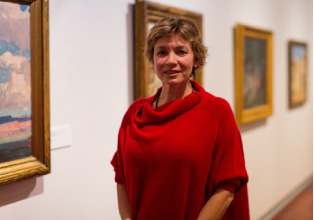
“Consider the intentions of the artists, the perspective of the painters,” says Mindy Wilson, Public Relations and Marketing Associate for UMFA. These early artists brought with them preconceived notions.
According to curator Donna Poulton, the early artists’ motives were not to exploit their subjects. Their motivation was to capture the scenes of a world they were aware was quickly changing. Nineteenth-century painters searched for authentic American scenes. A lover of history and art, Donna has a deep grounding in Utah art history. “It’s my passion; it’s what I do,” she says. “As curator—it’s a really great job—I look at what might interest patrons and students.”
The second movement travels to Taos and Santa Fe, New Mexico and shows portraits of the Pueblo people working, dancing, or posing for paintings. “Most are pretty authentic,” says Donna. A few of the paintings from the period are idealized, such as Minerva Bernetta’s Indian Captives at Night. Minerva created from her imagination large mural paintings for books. The Taos artists, classically trained in Paris, paid the natives to pose for portraits. They sought and found the European ideal of truth and beauty in nature in the Pueblo people who were relatively untouched by western civilization.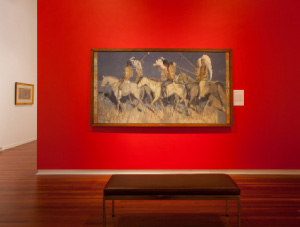
Contemporary works from the mid-20th century to 2012 represent more realistic portrayals of Native American culture. These artists step away from the stereotype of braves on horseback. Neo-impressionist-style Native American painter Shonto Begay’s My Grandfather’s Funeral and Helpless range from fantastical to startlingly realistic. Kevin Redstar’s Tea Party plays with timeworn clichés by portraying Native Americans living in white society while trying to maintain their cultural identity in the contemporary world.
Mid-twentieth century pop artists such as Andy Warhol with his screen prints of Sitting Bull and Geronimo, representing the American Indian exploited, attempt to break the depiction of the mythologized American Indian in which a clash of time, gender, and 500 native tribes are melded into one image. Roy Liechtenstein takes clichés, for example, rugs or a braid, and turns them upside down to construct a face with a grimace. Likewise, Bill Schenck tries to deconstruct stereotyping of American Indians with his “in your face” portrait, Pocahontas Awaits. Embedded in these portraits are deep images of meaning. They are more abstract and symbolic.
The UMFA exhibit is a broad spectrum historic representation of artists’ perceptions. Indeed, the image and reality of the Native American in America is continually evolving.