Marketplace

The Sweet Life: Cummings Chocolates

For nearly 80 years, Cummings Studio Candies has provided Utah with nothing but the best quality chocolates money can buy.

|


In hopes of impressing a girl, V. Clyde Cummings enrolled in a high school cooking where he learned he had a passion for making chocolate. Though his plan failed to win his crush’s affection, he had set in motion a journey that would win the hearts of many as one of the world’s finest chocolate makers.

Like every young dreamer, Clyde began his business from home. While in college, the young entrepreneur mixed chocolates in his mother’s basement and sold his hand-dipped delicacies to friends. Impressed, his tasters urged him to begin crafting chocolates more regularly. In 1924, Cummings leased part of a grocery store on 9th South and 7th East, just north of Liberty Park, the now-famous Cummings Studio Candies location.
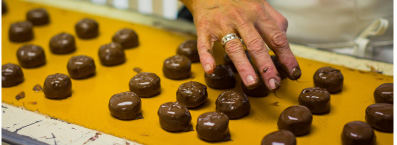
Cummings' world-famous chocolate truffles are made only from the finest ingredients
Cummings’ world-famous chocolate truffles are made from only the finest ingredients

His candy business turned global with sales in France, Pakistan and Hong Kong. Famous for their creamy, soft, and chewy chocolate centers, the sweets were made with the secret ingredients and mixing processes still used today.

These trade secrets were known only to Clyde’s son, Paul Cummings, who became head candymaster when Clyde passed away in 1959. The studio’s fame continued to grow with their truffles, long considered the Rolls Royce of candies, earning them the “Best in Show” at the International Truffles Contest.

Maintaining the spirit of a family-operated business, Paul’s wife, Marion Cummings, now owns and operates the world-famous chocolate factory, employing several of her grandchildren. Marion and Paul met when they were both students at East High School and were married until his death in 2000. Under Marion’s wing, Cummings Studio Candies has been featured prominently on the Food Network.

The store is decorated with pink ribbons, heart boxes, and stuffed animals. The candy counter is loaded with chocolates of all shapes and sizes (including specially molded and decorated stiletto heels). Production is somewhat limited, as preservatives are never used and the candies are all made by hand by a staff that has been with Cummings for decades. Orders can be customized to meet specifications, and boxes are gift wrapped in holiday-themed paper.

Valentine’s Day marks the company’s busiest single day of the year. To accommodate this intense demand, two policeman will be stationed in the parking lot to direct customers.

Cummings chocolates have been around for nearly 85 years. “I try to keep our product the same,” says Marion, when reflecting on her family’s success.

Only the best ingredients in the world are used to make their candy concoctions, including the the South American Tehuantepec chocolate, a delicacy so rare that Cummings Studio is the only candymaker in the US that uses this rich, tasty flavor.

When tasting the flavorful, smooth chocolate candies it’s apparent that Marion’s business principle works and that this recipe for success will likely retain its flavor for many years to come.

,

Join our newsletter.
Stay informed.


  • Whiskey, Bullets & a Buried Town: Archaeologists Reveal Alta’s Wild Past

    Before Alta was known for powder days and lift lines, it was a silver mining town clinging to the side of a narrow canyon. In the late 1800s, men lived at 8,000 feet, went underground each day, and endured winters that regularly buried buildings in snow. This past summer, that mining town resurfaced — literally — during construction at the Alta Ski Area.

    To understand what Alta really looked like, you don’t begin with legend. You begin with its trash — and this time, that happened almost by accident.

    Alta Ski Area was installing underground water reservoirs to support snowmaking. Because the project sits on Uinta-Wasatch-Cache National Forest land, an archaeologist was required to monitor the excavation. No one expected the trench to produce much.

    But, It did.

    Artifacts began surfacing almost immediately. Enough that the Forest Service contacted the Utah State Historic Preservation Office for help. Lexi Little, who coordinates the Utah Cultural Site Stewardship Program, helped mobilize nearly 30 volunteers to assist with what quickly became a focused two-week excavation.

    Winter deadlines were approaching. The pipes for the reservoirs had to go in the ground. There wasn’t time for a slow, extended dig.

    “It was two weeks of digging in the dirt and helping figure out exactly what we were looking at,” Little said.

    Most of the people screening soil weren’t professional archaeologists. They were trained stewards from around Utah — part of a statewide volunteer network that now approaches 500 people. They poured dirt through shaker screens, scanning for fragments that could piece together a town long buried.

    “Archaeology is human trash,” Little explained. “Archaeologists are very into trash.”

    Alta had left plenty behind.

    https://youtu.be/hzIHzx3OGoo?si=dKcl2CEz-t6FZzYw

    Victorian-style ceramics appeared first — the kind typically used in hotels. Medicine bottles followed. Ink bottles. Hand-blown glass. A porcelain doll’s foot surfaced from the soil, a small detail that shifted the mental image of the town. Families were here. Children were here. This wasn’t only a camp of miners.

    The bottles helped establish time. Manufacturing details — whether glass was hand-blown or mold-made, whether a maker’s mark appeared on the base — allowed archaeologists to date many of the artifacts to the 1870s through the 1890s, when Alta was booming as a silver mining town.

    “That gives you that range of dates for when Alta was really booming,” Little said.

    One reusable soda bottle clearly stamped “Salt Lake City” connected the canyon to the valley economy below.

    Then something unusual rolled out of a dirt pile.

    A corked bottle. Intact. Liquid still inside.

    Continue reading and support independent Utah journalism with a purchase of Utah Stories (Digital + Print) or 3 month free trial (Digital).


  • How Horses Help Kids Heal: Inside Utah’s Equine Therapy World

    Kelty Johnson trains horses for a living, but her deeper work happens in the quiet space between animal and human. On the Utah Stories podcast, she explains how equine therapy helps children regulate emotions, build confidence, and reconnect through presence rather than pressure.


  • Angela Brown: The Woman Behind SLUG Magazine and Craft Lake City

    Angela Brown is the publisher and owner of SLUG Magazine, one of the city’s longest-running independent publications and a central voice in Utah’s alternative arts and music scene. She is also the founder of Craft Lake City, a nonprofit that has grown into one of the state’s largest platforms for local makers and creative entrepreneurs.


  • Can Utahns Still Afford to Have Kids?

    When families cannot afford homes near their jobs, the daily math becomes brutal. Commutes stretch longer. Childcare costs pile up. Mortgages consume more of a household’s income. The result is what economists call “house-poor” families—people who technically own a home but have almost nothing left over to live on.

    The obvious question is: why isn’t this being fixed?