Utah Stories

The Power of Meditation and Overcoming the Impossible

One man overcomes spinal cord injury through meditation and occupational therapy.

|


V.J. Barry’s ongoing recovery to regain the use of his hands and legs is nothing short of a miracle. In 2000, Barry suffered a C6 spinal cord injury. He crashed in a Ski Cross, a race where four people ski down a run with obstacles and jumps. The accident left him paralyzed from the neck down, and he was diagnosed as a tetriplegic.
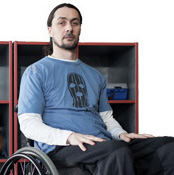
utah occupational therapyReferring to using his hands, now he can say, “There’s no one else in the world that can do this. Typically, the heart is the only muscle or organ that works on its own below the injury,” says V.J. After the accident, his breathing was affected, and he couldn’t cough or sneeze. Though he had some mobility in his hands, he couldn’t tear a tissue because it would slip out of his fingers. With the majority of people who have C6 level breaks, the tendons tighten and they can’t open their hands enough to use them. Fortunately, his hands were opened. He could move his arms but couldn’t pick anything up or even raise a one-pound weight above his head.

He left the hospital in Denver, where he says the policies were “old school,” and came to Health South in Utah. The occupational therapist there believed he could regain the use of his hands and arms. The hospital had a new machine that formulated exercises which simulated turning doorknobs and holding and twisting a screwdriver, or squeezing objects to increase strength and flexibility. Four months into his recovery, V.J started writing again.

One day he saw video of a friend’s uncle, an upside-down quad—meaning his arms were paralyzed, but he had some mobility in his legs—practicing walking across the gym in a program called Project Walk. Inspired, V.J. moved to California and became the second person to participate in Project Walk with a personal trainer.

His training involves stretching which gives him more control. “Energy flows when the body is in the correct positions,” he says. He also does breathing exercises, acupuncture, and meditation. He inhales deeply to the point of pain then slowly exhales. This relaxes the muscles and makes the spine more flexible.

“I get better every day,” he says. He walks on the treadmill, in water, or with arm braces, and does the elliptical machine for twenty minutes a day. He not only works out five days a week in the gym for three hours, but he also meditates five hours a day, which is probably why he exudes such an air of infectious serenity. Eating healthy makes a difference, too. His trainer, Casey Payzant, had him drink green drinks every day.

His biggest challenge is the pain. One way he copes is by writing poetry and songs. The lyrics are deep and poignant. “Some of them are so deep I don’t even get them myself,” he says with a laugh.

Positive thinking has been a big help. People try to box you in and tell you what you can and can’t do, but with God your potential is much greater. “How do you use your mind so your mind doesn’t use you?” he asks. His answer is that he tries to lift himself by lifting others. “If I give them something positive they have no choice but to give back positive energy.”

“You are limitless,” he says and he is an incredible example of that. He plans to ski again in the near future, maybe this year. His brother Scott, who works with him as a partner at Viice Skis making custom skis, says V.J. will ski this year even if Scott has to put him in a sit bucket and send him down the mountain.



Join our newsletter.
Stay informed.


  • Artist Kate Kilpatrick Brings Utah’s History to Life Through Murals

    “I think we’re all interconnected; as individuals as well as societies,” Kilpatrick notes. Her work showcases those connections exuberantly, and whatever scale she’s working on, you can bet that in terms of energy and spirit, she’s painting large.


  • Why Most People Stay Stuck in Business and What It Takes to Move Forward

    Every so often, you meet an immigrant who came here with almost nothing and managed to build something exceptional.

    Prakash Shah is the kind of man who has spent enough time around risk that he no longer treats it like an interruption.

    Today, he works in business brokerage and advisory, helping owners sell companies, helping buyers decide whether they should step in, and, when the fit is right, helping connect those buyers with private equity. He works in a world of valuations, leverage, due diligence, and hard questions that most people would rather postpone. He also operates in Utah real estate and has built a career around seeing value before it is obvious to everyone else. That is who he is now. What makes him interesting is how early that instinct started to form, and how little his life resembles the way most Americans are raised to think about comfort, career, and security.

    He grew up in Nepal in a boarding school system that would feel severe to many Americans. He was an only child, yet he saw his parents only twice a year for twelve straight years, until high school graduation. He lived inside routine. He shared space with boys from different social classes and different family circumstances. The school was structured enough that money did not buy you any special standing once you were inside. Everyone followed the same rules. Everyone was subject to the same discipline. In his case, it was an army school. Everything was measured. Everything was scheduled. In that kind of environment, you do not build your life around preference. You build it around adaptation.

    That contrast matters.

    A lot of American children are raised to search for what fits them. What are you passionate about? What do you enjoy? What feels right? Those are not bad questions, but they can create a habit of waiting for life to align itself before action begins. Prakash learned something else much earlier. He learned that life often does not align itself first. You enter the room as it is, you deal with the people in it, and you figure out how to function without making your comfort the center of every decision. He said that one of the biggest lessons from those years was tolerance, the ability to live with people from all walks of life and genuinely learn to get along with them. That is not a soft value. In business, it turns into resilience. In negotiation, it turns into patience. In career terms, it turns into range.

    When he came to the United States over 25 years ago, he did not arrive with the kind of runway that allows for a prolonged identity search. He came with two suitcases and enough money for one semester. He went to Hunter College in New York City, then to NYIT near Central Park, studying media and then media and technology management. He also studied psychology. Those details matter because they show something about his mind. He was interested in people before he built a career around deals. Even then, what attracted him was not technical prestige. It was understanding motives, behavior, and how people reveal themselves.

    But New York is merciless toward vague ambition. It demands payment in rent, transit, food, and time.

    Prakash worked constantly. He took multiple jobs. He paid tuition, paid rent, and skipped most of what Americans imagine as college life. There were no romantic years of drifting from café to concert to self-discovery. He talked about not having the luxury of dates, travel, or finding himself. He was working. Even laundry was not a small detail. In New York, he pointed out, you do not just throw clothes in a machine at home. You haul them to the laundromat, count quarters, and measure what is necessary. He also described distraction in a way that most native-born Americans probably do not think about. For immigrants, distraction is not always pleasure. Sometimes distraction is the constant pressure of competing needs. Tuition or rent. Food or savings. A better coat or another month of making do. He was not romanticizing the struggle. He was describing the arithmetic of it.

    That arithmetic did not make him cautious. If anything, it did the opposite.

    While in college, he had the option of safer analytical work. Instead, he took a sales job with Time Warner Cable that sent him into the South Bronx from 6 p.m. to 10 p.m. to knock on doors. He is not a physically imposing man. He knew exactly what kind of neighborhoods he was walking into. He described apartment buildings where people kept pit bulls, where tension was normal, where one mistake in tone or timing could end a conversation immediately. For most people, that kind of job would have been something to survive and forget. For him, it became a school in human behavior. “It’s not about talking… it’s about listening,” he said.

    One story from that period says almost everything about how he operates. He knocked on a door one night around 8:45 and found himself facing a huge man with a gun on the table, pit bulls nearby, and a half-eaten pizza in front of him. It had all the ingredients of a very bad scene.

    Continue reading and support independent Utah journalism with a purchase of Utah Stories (Digital + Print) or 3 month free trial (Digital).


  • Ancient Pyramid Discovered in Sugar House Park, Salt Lake City

    A Salt Lake City resident says he may have uncovered what he believes to be a buried structure beneath a well-known hill in Sugar House Park, raising questions that have drawn both curiosity and skepticism.


  • Utah Fits All Scholarship Applications Open Through April 30 for K–12 Students

    Utah families have more learning paths than ever and, increasingly, more ways to make those paths affordable. This spring, the Utah Fits All Scholarship opened  for new family applications on April 1, and the application window stays open for one month. The program is a public K–12 scholarship that provides $4,000 to $8,000 per student,…