
Local Spotlight

Painting with Passion: Ancient Arts in the Modern Era

Walt Bayless is a bold and ephemeral artist with a style that speaks of strength passion, and protection in an unforgiving world.

|


walt bayless utah artistThink Beastmaster: strong men wielding swords, animal skins on warrior princesses. This is not the art you hang on your walls because it goes nicely with your wallpaper, Walt’s style speaks of strength, passion and protection in an unforgiving world.

Walt Bayless is an artist with a bold and ephemeral style. His paintings are full of action and emotion. Walt says, “Every painting is like a self portrait, a fitting description because Walt is a real life martial arts warrior.

Bayless can’t remember a time when he didn’t have an interest in art. He can clearly remember drawing at age four. He drew monsters and dinosaurs and says, “They meant so much to me. I felt like I was creating a little friend.” He went on to say it was like using another language or another way to express himself and a way to get approval.

A self-taught artist who, “likes putting people and animals in motion,” he tried art classes, but to him, they seemed pointless. Teachers would assign a subject to draw and then just walk around the room observing. He decided early on that you could either talk about something or do it. That is not to say he didn’t have any influential teachers or role models.

He remembers a teacher who was an encouraging influence. One day during class, his history teacher spied one of Walt’s creations while conducting his lecture, slamming his hand down on Walt’s desk he exclaimed, “Yes!” That simple and abrupt validation from a teacher he admired encouraged him to keep developing as an artist.

Since he wasn’t enamored with art classes, Walt looked to his favorite painters for inspiration and technique. He admires Frank Frazetta, whose work features strong scantily clad warrior women beside roaring saber tooth tigers, influence visible in Walt’s work. He also likes Hal Foster as well as other fantasy and comic artists.

He studied the old masters on his own, their style and application. He was particularly drawn to Giovanni Tieplo, whose work features Biblical scenes in a regal and somewhat mythical presentation. He asked himself, “How do I get my stuff to look like theirs and then keep going until it gets better.” The answer came in the form of dedication, self study and inspiration.

Walt went through a time when he stopped painting. He feels his art started to reflect the personal turmoil in his life. He says, “There was a time when I was surrounded by people who wanted to monetize my life. My art became commercial based rather than art based. When I shed the bad elements in my life, the art came back because I was happy.” During that time he had a gallery exhibit of some of his wildlife paintings. He was so unhappy with his work he says, “I wanted to feed myself to the animals in the pictures.”

When the problems in his life resolved he picked up his paintbrushes again.

Walt decided the best way to enjoy his art was to keep it in the realm of his life of pure passion and artistic liberty. He did this by deciding to no longer sell his pieces in galleries nor accept commissions for fantasy books. Now Walt’s art is purely for “self-fulfilment and happiness.”  He shares his work through social media with friends and family.
Walt works in pencil, charcoal, pen, ink, acrylic and oil, but right now he really loves working in watercolors. He says, “Watercolors allow me to be abstract and subjective at the same time. It is not natural to see things as a camera does.”

He is also a martial artist and developed a system of jiu jitsu called Walt Bayless Combat Jiu Jitsu. Along with his desire to return to painting he realized a desire to return to
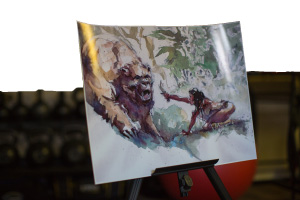
"On the Edge," watercolor 2012
“On the Edge,” watercolor 2012

teaching martial arts.

He is an amazing natural athlete and those who have studied under him are devoted. Many still keep the shirts with logos he designed from 20 years ago and hang on to the set of VHS tapes he made to demonstrate his techniques and philosophy. Walt believes that is it all about connection, whether in painting or training. He says, “People long for perfection. You can see a picture or visualize a move and it makes you think it could happen. It’s about making a door to walk through.”

When asked which painting is his favorite he decides it is one called, “Stand Against the Demons”. It symbolizes the fight in his life to get where he is today. He also says, “The paintings that are important are the ones I haven’t done yet.”

Walt posts many of his paintings on his website, www.waltbayless.com.

, ,


Join our newsletter.
Stay informed.


  • Artist Kate Kilpatrick Brings Utah’s History to Life Through Murals

    “I think we’re all interconnected; as individuals as well as societies,” Kilpatrick notes. Her work showcases those connections exuberantly, and whatever scale she’s working on, you can bet that in terms of energy and spirit, she’s painting large.


  • Utah Youth Ice Climbers Win World Championships Thanks to Millcreek Common Wall

    Utah is home to two new World Champion youth ice climbers, and the ice climbing wall at Millcreek Common is getting credit for helping them win. 


  • Why Most People Stay Stuck in Business and What It Takes to Move Forward

    Every so often, you meet an immigrant who came here with almost nothing and managed to build something exceptional.

    Prakash Shah is the kind of man who has spent enough time around risk that he no longer treats it like an interruption.

    Today, he works in business brokerage and advisory, helping owners sell companies, helping buyers decide whether they should step in, and, when the fit is right, helping connect those buyers with private equity. He works in a world of valuations, leverage, due diligence, and hard questions that most people would rather postpone. He also operates in Utah real estate and has built a career around seeing value before it is obvious to everyone else. That is who he is now. What makes him interesting is how early that instinct started to form, and how little his life resembles the way most Americans are raised to think about comfort, career, and security.

    He grew up in Nepal in a boarding school system that would feel severe to many Americans. He was an only child, yet he saw his parents only twice a year for twelve straight years, until high school graduation. He lived inside routine. He shared space with boys from different social classes and different family circumstances. The school was structured enough that money did not buy you any special standing once you were inside. Everyone followed the same rules. Everyone was subject to the same discipline. In his case, it was an army school. Everything was measured. Everything was scheduled. In that kind of environment, you do not build your life around preference. You build it around adaptation.

    That contrast matters.

    A lot of American children are raised to search for what fits them. What are you passionate about? What do you enjoy? What feels right? Those are not bad questions, but they can create a habit of waiting for life to align itself before action begins. Prakash learned something else much earlier. He learned that life often does not align itself first. You enter the room as it is, you deal with the people in it, and you figure out how to function without making your comfort the center of every decision. He said that one of the biggest lessons from those years was tolerance, the ability to live with people from all walks of life and genuinely learn to get along with them. That is not a soft value. In business, it turns into resilience. In negotiation, it turns into patience. In career terms, it turns into range.

    When he came to the United States over 25 years ago, he did not arrive with the kind of runway that allows for a prolonged identity search. He came with two suitcases and enough money for one semester. He went to Hunter College in New York City, then to NYIT near Central Park, studying media and then media and technology management. He also studied psychology. Those details matter because they show something about his mind. He was interested in people before he built a career around deals. Even then, what attracted him was not technical prestige. It was understanding motives, behavior, and how people reveal themselves.

    But New York is merciless toward vague ambition. It demands payment in rent, transit, food, and time.

    Prakash worked constantly. He took multiple jobs. He paid tuition, paid rent, and skipped most of what Americans imagine as college life. There were no romantic years of drifting from café to concert to self-discovery. He talked about not having the luxury of dates, travel, or finding himself. He was working. Even laundry was not a small detail. In New York, he pointed out, you do not just throw clothes in a machine at home. You haul them to the laundromat, count quarters, and measure what is necessary. He also described distraction in a way that most native-born Americans probably do not think about. For immigrants, distraction is not always pleasure. Sometimes distraction is the constant pressure of competing needs. Tuition or rent. Food or savings. A better coat or another month of making do. He was not romanticizing the struggle. He was describing the arithmetic of it.

    That arithmetic did not make him cautious. If anything, it did the opposite.

    While in college, he had the option of safer analytical work. Instead, he took a sales job with Time Warner Cable that sent him into the South Bronx from 6 p.m. to 10 p.m. to knock on doors. He is not a physically imposing man. He knew exactly what kind of neighborhoods he was walking into. He described apartment buildings where people kept pit bulls, where tension was normal, where one mistake in tone or timing could end a conversation immediately. For most people, that kind of job would have been something to survive and forget. For him, it became a school in human behavior. “It’s not about talking… it’s about listening,” he said.

    One story from that period says almost everything about how he operates. He knocked on a door one night around 8:45 and found himself facing a huge man with a gun on the table, pit bulls nearby, and a half-eaten pizza in front of him. It had all the ingredients of a very bad scene.

    Continue reading and support independent Utah journalism with a purchase of Utah Stories (Digital + Print) or 3 month free trial (Digital).


  • Ancient Pyramid Discovered in Sugar House Park, Salt Lake City

    A Salt Lake City resident says he may have uncovered what he believes to be a buried structure beneath a well-known hill in Sugar House Park, raising questions that have drawn both curiosity and skepticism.