Collection Obsessions

Utah’s King of Collectors

Utah’s king of collectors Harold Robert Campbell collects everything from guns, dolls, relics, rocks, and minerals.

|


Bob Campbell started collecting cigarette butts as a boy. Today his collection is really smoking.
utahkingofcollectors
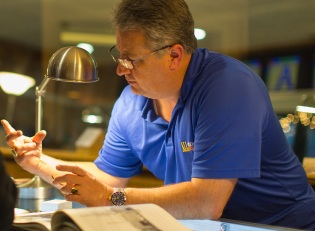
Utah collector Harold Robert Campbell

Harold Robert Campbell collects every collectible imaginable. “The problem,” he says, “is figuring out what I don’t collect.” It is an obsession he can trace back to his earliest memories. Undiagnosed dyslexia and losing his dad just before he turned five left Robert with a need to find order in the world.

He started collections whenever he found two of anything that were similar. He collected sticks, rocks, bottle caps, thimbles, rope, spools of thread, bandages, new and used, and a few things that didn’t please his mother like lint, cigarette butts and old fingernails.

Campbell said that when he was newly married he was collecting pieces of mining and railroad rail. The pieces were one-yard long with the patent and manufacturing dates stamped into the ends. They were heavy and when his wife stubbed her toe on one they had to go. That incident did not deter him from broadening his collections.

One of his collections is an assortment of poison bottles from the early 1900s. Their distinctive three-sided shape was designed to help people avoid accidental poisoning when reaching into the medicine cabinet at night.

He has an impressive collection of pirate-era pieces of eight. The pieces are all different shapes, but what was important was the weight. The coins contain 27 grams of silver, were made in the New World and then shipped back to Spain. He also has gold doubloons minted in the same way.

Campbell collects guns, dolls, relics, rocks and minerals. Some of his favorite pieces are his impressive heavy gold nuggets. His rock and mineral collection even inspired him to pursue a degree in petroleum geology.

Adding to his book collection, Campbell recently acquired a Pony Express Bible. The riders were all given one so that they would have something to read during their rest time and he was able to find a well-preserved volume.
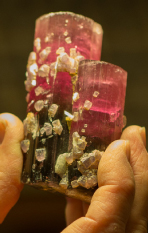
Gem's are a part of Robert's many collections. This watermelon tourmaline specimen was found in California.
Gem’s are a part of Robert’s many collections. This watermelon tourmaline specimen was found in California.

Along with the material items Robert accumulates, he also collects the stories that go along with them. He knows the value, place of origin and the tales behind his pieces. Through collecting he has cultivated a love of history. But, he says, “The most fun is the hunt.” He will find something he wants to add to a collection and at times wait years to acquire it.

His collections have also led him to a life of adventures. His father left behind a Pony Express medal. He said he was always fascinated by it and learned all he could about the Pony Express. He joined a group that sponsors a commemorative ride along the route. Being a young man from Utah, they assumed he could ride. “I was a city boy with no experience with horses,” he says. They sent him out alone on the trail in the dark for his section of the ride. He half expected to be thrown from the horse and die on the trail. It was an experience he will never forget.

His father had been a jeweler and watch repairman and Robert gravitated to the crafts his father did. Among his father’s things was a white box containing coins from around the world. He went through the coins over and over again. Robert had two brothers with an equal claim to the legacy but, he says, “I bought out my brothers’ interest when I was a teenager.”

So perhaps his greatest love is his coin collection which his father inspired. The collection includes rare and ancient coins from all over the world. He started out as a vest pocket dealer, someone who bought and sold coins between shops without a store of his own.

He then worked at a coin shop in Sugar House and eventually bought it without any inventory at all for $2,500. Starting with just the store space he built his business, All About Coins, into a multi-million dollar a year venture.

From a boy who collected sticks to find order in the world Campbell has built a lifetime collection of adventure, knowledge and success.
,


Join our newsletter.
Stay informed.


  • Highway 6 and the Midland Trail: Utah’s Transcontinental Highway History

    From Price Canyon to Delta’s desert stretch, Utah played a central role in building the Midland Trail, one of America’s earliest transcontinental highways and the foundation of today’s Highway 6.


  • Whiskey, Bullets & a Buried Town: Archaeologists Reveal Alta’s Wild Past

    Before Alta was known for powder days and lift lines, it was a silver mining town clinging to the side of a narrow canyon. In the late 1800s, men lived at 8,000 feet, went underground each day, and endured winters that regularly buried buildings in snow. This past summer, that mining town resurfaced — literally — during construction at the Alta Ski Area.

    To understand what Alta really looked like, you don’t begin with legend. You begin with its trash — and this time, that happened almost by accident.

    Alta Ski Area was installing underground water reservoirs to support snowmaking. Because the project sits on Uinta-Wasatch-Cache National Forest land, an archaeologist was required to monitor the excavation. No one expected the trench to produce much.

    But, It did.

    Artifacts began surfacing almost immediately. Enough that the Forest Service contacted the Utah State Historic Preservation Office for help. Lexi Little, who coordinates the Utah Cultural Site Stewardship Program, helped mobilize nearly 30 volunteers to assist with what quickly became a focused two-week excavation.

    Winter deadlines were approaching. The pipes for the reservoirs had to go in the ground. There wasn’t time for a slow, extended dig.

    “It was two weeks of digging in the dirt and helping figure out exactly what we were looking at,” Little said.

    Most of the people screening soil weren’t professional archaeologists. They were trained stewards from around Utah — part of a statewide volunteer network that now approaches 500 people. They poured dirt through shaker screens, scanning for fragments that could piece together a town long buried.

    “Archaeology is human trash,” Little explained. “Archaeologists are very into trash.”

    Alta had left plenty behind.

    https://youtu.be/hzIHzx3OGoo?si=dKcl2CEz-t6FZzYw

    Victorian-style ceramics appeared first — the kind typically used in hotels. Medicine bottles followed. Ink bottles. Hand-blown glass. A porcelain doll’s foot surfaced from the soil, a small detail that shifted the mental image of the town. Families were here. Children were here. This wasn’t only a camp of miners.

    The bottles helped establish time. Manufacturing details — whether glass was hand-blown or mold-made, whether a maker’s mark appeared on the base — allowed archaeologists to date many of the artifacts to the 1870s through the 1890s, when Alta was booming as a silver mining town.

    “That gives you that range of dates for when Alta was really booming,” Little said.

    One reusable soda bottle clearly stamped “Salt Lake City” connected the canyon to the valley economy below.

    Then something unusual rolled out of a dirt pile.

    A corked bottle. Intact. Liquid still inside.

    To access this post, you must purchase Utah Stories (Digital + Print) or 3 month free trial (Digital).


  • The Only Full Bottle of Alcohol Ever Found in Utah Was Unearthed in Alta

    When a backhoe rolled a corked bottle out of the dirt at Alta this summer, no one immediately grasped what they were holding. It wasn’t empty. It wasn’t shattered. It was full. “The bottle that was discovered up at Alta is the only bottle of alcohol ever discovered in an archaeological excavation in the state…


  • How Horses Help Kids Heal: Inside Utah’s Equine Therapy World

    Kelty Johnson trains horses for a living, but her deeper work happens in the quiet space between animal and human. On the Utah Stories podcast, she explains how equine therapy helps children regulate emotions, build confidence, and reconnect through presence rather than pressure.