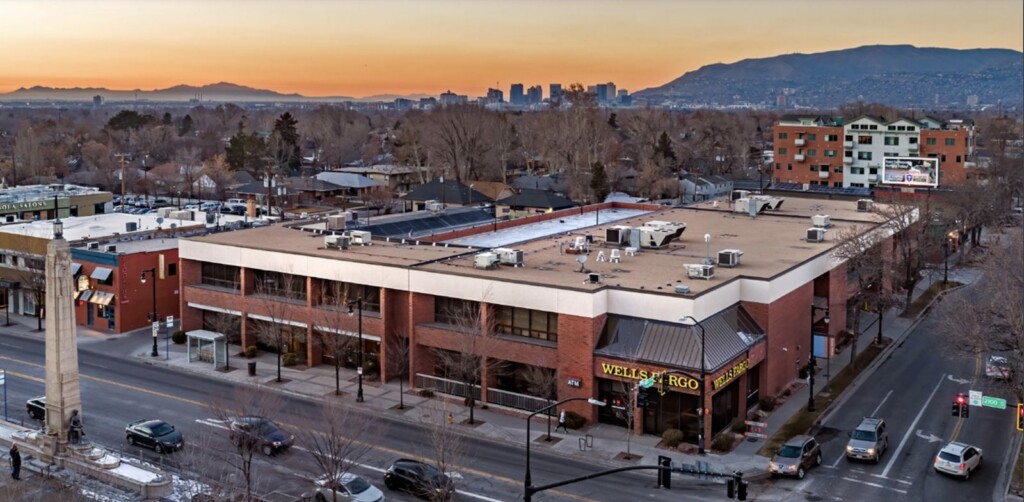
Have you noticed the concrete “couches” arranged near bus stops and businesses in the Sugar House Business District? These public artworks by Eric Thelander are a reference to the days when Sugar House was known as the Furniture Center of the West.
At one time, as many as twenty-one stores in the town center sold furniture, lighting, or other household furnishings. Mark Williamson of Sterling Furniture said that Highland Drive was once called Design Boulevard, and the furniture stores held an annual Home Furnishings Fashion Show.
The largest of the stores, Granite, South East, Rockwood, Ray Nilson, Sterling, and Ideal, were locally-owned, often with many family members involved in the business. Most of the stores are now closed. The Johnsons adapted their Rockwood Furniture building to its current use as the Rockwood Artists’ Studios. Granite Furniture Company reorganized in 2005, and the Richards family sold their flagship store to Boulder Ventures Development Inc. for a mixed–use project, “2100 Sugar House.” The Sorensen family closed South East Furniture and transferred their property to Mecham Management Inc. The building was demolished in 2008 and will eventually be replaced by the new “Sugar House Crossing” complex. Only one of the big-six stores is still in business in its original location.
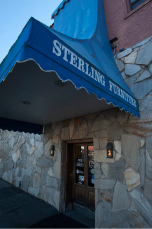
Sterling Furniture Co. opened in Sugar House in 1941, in a building formerly occupied by J.A. Rockwood Co., and before that, by Sugar Banking Co. F.W. Madsen, Jr. and his brother Francis purchased the store in 1937. They also bought a large block of land around the store, extending north on 1100 East and up the north side of 2100 South, almost to Elizabeth St. The furniture store was flanked by smaller buildings that were occupied by a federal post office, a state liquor store and local businesses such as Sugar House Glass & Paint Co.
Duncan Williamson recalls that the 1940s and ‘50s were very good for small businesses in the area. Williamson joined Sterling Furniture Co. in 1956 and is now the manager. He remembers well the shops that that lined 1100 East and 2100 South. Many other long-time residents mention Fire Station No. 3, Phil and Joe’s South East Repair Shop, Stevens–Brown Sporting Goods, and The Bulletin print shop in their recollections of old Sugar House.
Beginning in 1875, Hans Madsen and his descendants founded Madsen’s Furniture, P.W. Madsen’s, and Standard Furniture as well as the Sterling Co. Through their mother, Donna Madsen Williamson, Debie and Mark Williamson are the sixth generation of the Madsen family to sell home furnishings in Salt Lake City and the third to operate in Sugar House. Mark manages the properties that surround the Sterling building. In 1954, the company replaced the old wooden buildings and boardwalks with the stores where Mehio’s, Fankhauser’s, Central Book Exchange and All About Coins do business today. Williamson says that when one of the spaces becomes available, his company advertises for another small, stable business that will add something to the neighborhood. The latest additions are Unhinged, which specializes in one-of-a kind and locally-made clothing and oddities, and ZAGG, a Utah-based company that makes invisible shields and cases for iPad and iPhone.
Twenty-five years ago, the concept of mixed-use development seemed antithetical to good business practice in Sugar House. But Sterling has embraced this model for decades. The Sterling Furniture building is home to the 14-unit Madsen Apartments (formerly the Sterling Apartments), which have been occupied continuously since 1927.
Sterling Furniture Co. is a model for the type of urban design that is desirable in Sugar House. The proposed new transit-oriented development cannot improve on the traditional, pedestrian-scale block that embraces single-story retail shops and a historical, multi-story mixed use building that is now the last remnant of the days when Sugar House was the Furniture Capital of the West.