Utah Stories

Larry H. Miller’s Legacy

Business Mogul, Utah Sports hero of the most unusual sort, dies at 64. by Richard Markosian Nearly every NBA basketball team has an overweight, overly emotional super fan. But there will never be another super fan like Larry H. Miller. Without Miller there would almost certainly be no Utah Jazz basketball franchise in Utah. Larry…

|


Business Mogul, Utah Sports hero of the most unusual sort, dies at 64.

by Richard Markosian

larry h miller

Nearly every NBA basketball team has an overweight, overly emotional super fan. But there will never be another super fan like Larry H. Miller. Without Miller there would almost certainly be no Utah Jazz basketball franchise in Utah.

Larry H. Miller was not a man afraid of risk. The Jazz came to Utah a losing team: they lost on their long time run with “Pistol” Pete Maravich, who was a great showman and tremendous all star but not much of a team player. They had lost on what should have been an amazing franchise player Adriane Dantly, who was a prolific scorer but could not cary the franchise to a winning record.

Then after their first year of business in Utah, the Jazz were showing even more loss on their balance sheet than they were in New Orleans. After five more years of losses in Utah, Jazz Owner Sam Battistone must have been surprised to see a local car dealer with enough hutzba interested in buying the sinking franchise.

Larry H. Miller decided to purchase the losing franchise simply because he was huge sports fan and wanted the Utah Jazz team to stay in Utah.

Miller bought 50 percent of the Jazz franchise on April 11, 1985 for $9.5 million. Miller’s first season as partner likely showed promise due to Miller’s marketing savy (but there is also a dearth of information in this regard **). The Jazz’s new star Darrell Griffith (Dr. Dunkenstein) showed team leadership while Adrine Dantley proved a disappointment, playing only 55 games due to wrist injury. The bright note of the Jazz’s 41-41 record was that they would have a first round pick in the 1985 NBA draft.
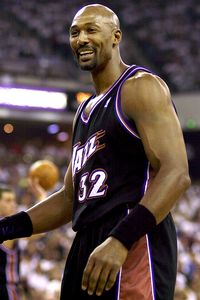
karl malone

The extent of Miller’s involvement in choosing Karl Malone 13th draft pick out of Louisiana Tech–just three months after becoming half owner– is unclear. But this choice would be known as one of the best draft picks in NBA history. After Malone’s first season (1985-1986) averaging 15 points and 9 rebounds, the Jazz decided to trade Adriane Dantley and build the franchise around their new power forward Malone. The Utah Jazz were poised for a promising future built around Malone, Griffith and veteran guard Ricky Green. Miller then wanted to buy the remaining half of the team. Despite lower attendence at the Salt Palace in 85 than in 84, and being eliminated the first round of the playoffs– Battistone negotiated for nearly twice as much for the remaining 50% share of the franchise. The final price Miller paid for the remaining interest of the Jazz was $17.3 million.

Most Jazz fans believed that Karl Malone would be supported by starting point guard Ricky Green, but the little white guy sitting on the bench named John Stockton had other plans. And by 1988 the dynamic duo of Stocton and Malone became well known as far away as China and Russia.
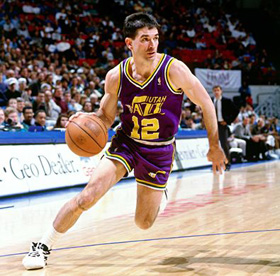
John Stockton

Miller attendend nearly every Jazz home game, and Jazz fans loved watching Miller watch his team. Miller– like a kid watching his favorite TV program– was a highly interactive observer. He interacted with players, the refs, the fans. Miller’s emotions regarding the performance of his team were obvious. Miller’s emotional appeals to players during half-time and teary-eyed contract negotiations with Malone–who often felt too big for little SLC–kept Jazz fans rivited.
larry h miller upset

As the Jazz franchise grew and flourished, so did Millers’ automotive dealership empire. With dealerships like Karl Malone Toyota and Stockton-to-Malone Honda; Miller knew that by attaching his name and his players names to his reputation as — the guy who kept the Jazz in Utah– more customers would patronize his automotive empire.

Larry H. Miller went on to take many more financial risks in his lifetime: he purchased a local TV station then renamed it KJZZ. Miller then offered loal viewers all the games fans couldn’t watch on cable.

Miller also opened several Megaplex theaters. When a movie called “Brokeback Mountain” was released showing two homosexual men kissing, Miller decided that he didn’t want to display men kissing in his theaters. Subsequently, gay activits protested and boycotted Miller’s businesses.
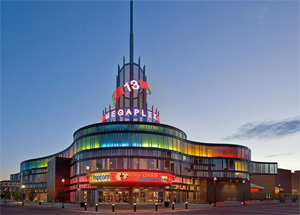
larry miller megaplex

After a trip to Denver’s Casa Bonita restaurant, featuring indoor waterfalls and cliff divers that Miller thought were cool– Miller decided to open a similar restaurant at his Jordan Commons called “the Mayan Adventure” featuring animatronic talking parrots, cliff divers and synthetic 50 foot tall cliffs. Casa Bonita later filed a lawsuite of copyright infringement due to his new restaurant idea. The Mayan serves Mexican food. Like many Utahns, Miller didn’t understand that Peruvian and Yucatan cuisine differ significantly from Mexican food; but chances are very few diners at the Mayan notice the cultural gaff.

Miller then made his final dream a reality by building the largest and best race car track in North America at the Miller Motorsport Park, which now hosts many international circuit race events as well as monster truck ralleys– which we in Utahn can never get enough of.

Despite all later accomplishments, Miller will always be remembered for his saving the Jazz franchise then turning the team into the dominent force it became in the NBA. I will never forget the noise meter displayed on the Delta Center jumbo tron–seemingly orchestrated by Millers’ enthusiasum– which gave the Delta Center the reputation for being the loudest arena, and one of the most winning records due to the crazy Utah Jazz fans.


Larry H. Miller on Utah Hall of Fame


Join our newsletter.
Stay informed.


  • Artist Kate Kilpatrick Brings Utah’s History to Life Through Murals

    “I think we’re all interconnected; as individuals as well as societies,” Kilpatrick notes. Her work showcases those connections exuberantly, and whatever scale she’s working on, you can bet that in terms of energy and spirit, she’s painting large.


  • Why Most People Stay Stuck in Business and What It Takes to Move Forward

    Every so often, you meet an immigrant who came here with almost nothing and managed to build something exceptional.

    Prakash Shah is the kind of man who has spent enough time around risk that he no longer treats it like an interruption.

    Today, he works in business brokerage and advisory, helping owners sell companies, helping buyers decide whether they should step in, and, when the fit is right, helping connect those buyers with private equity. He works in a world of valuations, leverage, due diligence, and hard questions that most people would rather postpone. He also operates in Utah real estate and has built a career around seeing value before it is obvious to everyone else. That is who he is now. What makes him interesting is how early that instinct started to form, and how little his life resembles the way most Americans are raised to think about comfort, career, and security.

    He grew up in Nepal in a boarding school system that would feel severe to many Americans. He was an only child, yet he saw his parents only twice a year for twelve straight years, until high school graduation. He lived inside routine. He shared space with boys from different social classes and different family circumstances. The school was structured enough that money did not buy you any special standing once you were inside. Everyone followed the same rules. Everyone was subject to the same discipline. In his case, it was an army school. Everything was measured. Everything was scheduled. In that kind of environment, you do not build your life around preference. You build it around adaptation.

    That contrast matters.

    A lot of American children are raised to search for what fits them. What are you passionate about? What do you enjoy? What feels right? Those are not bad questions, but they can create a habit of waiting for life to align itself before action begins. Prakash learned something else much earlier. He learned that life often does not align itself first. You enter the room as it is, you deal with the people in it, and you figure out how to function without making your comfort the center of every decision. He said that one of the biggest lessons from those years was tolerance, the ability to live with people from all walks of life and genuinely learn to get along with them. That is not a soft value. In business, it turns into resilience. In negotiation, it turns into patience. In career terms, it turns into range.

    When he came to the United States over 25 years ago, he did not arrive with the kind of runway that allows for a prolonged identity search. He came with two suitcases and enough money for one semester. He went to Hunter College in New York City, then to NYIT near Central Park, studying media and then media and technology management. He also studied psychology. Those details matter because they show something about his mind. He was interested in people before he built a career around deals. Even then, what attracted him was not technical prestige. It was understanding motives, behavior, and how people reveal themselves.

    But New York is merciless toward vague ambition. It demands payment in rent, transit, food, and time.

    Prakash worked constantly. He took multiple jobs. He paid tuition, paid rent, and skipped most of what Americans imagine as college life. There were no romantic years of drifting from café to concert to self-discovery. He talked about not having the luxury of dates, travel, or finding himself. He was working. Even laundry was not a small detail. In New York, he pointed out, you do not just throw clothes in a machine at home. You haul them to the laundromat, count quarters, and measure what is necessary. He also described distraction in a way that most native-born Americans probably do not think about. For immigrants, distraction is not always pleasure. Sometimes distraction is the constant pressure of competing needs. Tuition or rent. Food or savings. A better coat or another month of making do. He was not romanticizing the struggle. He was describing the arithmetic of it.

    That arithmetic did not make him cautious. If anything, it did the opposite.

    While in college, he had the option of safer analytical work. Instead, he took a sales job with Time Warner Cable that sent him into the South Bronx from 6 p.m. to 10 p.m. to knock on doors. He is not a physically imposing man. He knew exactly what kind of neighborhoods he was walking into. He described apartment buildings where people kept pit bulls, where tension was normal, where one mistake in tone or timing could end a conversation immediately. For most people, that kind of job would have been something to survive and forget. For him, it became a school in human behavior. “It’s not about talking… it’s about listening,” he said.

    One story from that period says almost everything about how he operates. He knocked on a door one night around 8:45 and found himself facing a huge man with a gun on the table, pit bulls nearby, and a half-eaten pizza in front of him. It had all the ingredients of a very bad scene.

    Continue reading and support independent Utah journalism with a purchase of Utah Stories (Digital + Print) or 3 month free trial (Digital).


  • Ancient Pyramid Discovered in Sugar House Park, Salt Lake City

    A Salt Lake City resident says he may have uncovered what he believes to be a buried structure beneath a well-known hill in Sugar House Park, raising questions that have drawn both curiosity and skepticism.


  • Utah Fits All Scholarship Applications Open Through April 30 for K–12 Students

    Utah families have more learning paths than ever and, increasingly, more ways to make those paths affordable. This spring, the Utah Fits All Scholarship opened  for new family applications on April 1, and the application window stays open for one month. The program is a public K–12 scholarship that provides $4,000 to $8,000 per student,…